
Further experiments with Seurat. The code is better organized, and I have more control over “artistic” parameters such as color velocity, particle spacing, and alpha transparency.
Further experiments with Seurat. The code is better organized, and I have more control over “artistic” parameters such as color velocity, particle spacing, and alpha transparency.




The following quote, often attributed to Einstein, is a gem:
Not everything that can be counted counts, and not everything that counts can be counted.
However, QuoteInvestigator points out that it is likely due to the sociologist William Bruce Cameron, who wrote the following in his 1963 text Informal Sociology: A Casual Introduction to Sociological Thinking.
It would be nice if all of the data which sociologists require could be enumerated because then we could run them through IBM machines and draw charts as the economists do. However, not everything that can be counted counts, and not everything that counts can be counted.

I’m making progress on the black box to control Seurat. Below is the left half of a recent frame from the program, and below that is a photo of the black box, a breadboard with a small circuit, and an Arduino board.

There are four knobs on the box, two of which are hooked up and two switches which I will mount later. One switch selects the bank of controls to use (I have only six, the number of analogue input pins on the Arduino board). At present I can control color, object size, and frame rate with the knobs and switches. To add: alpha, color velocity, a selector shape.


Seurat, frame 4203
The Processing sketch from which the frame above was taken now has a name: Seurat. It has controls (radius and frame rate) that can be operated by the slider (linear potentiometer) and the joystick on an Arduino Esplora board. Arduino reads the sensor data and sends it to Processing over the serial (USB) port.
Code for Seurat | Code for Arduino

Arduino Esplora board
The next step in this project is to build a box with lots of knobs and switches to control Seurat via a standard Arduino board.
Credits: Jeremy Blum’s blog was a great help in figuring out how to make Arduino talk to Processing. Mark Frauenfelder post at boingboing.net has a useful (and fun) video on how to make a good enclosure for the electronics.
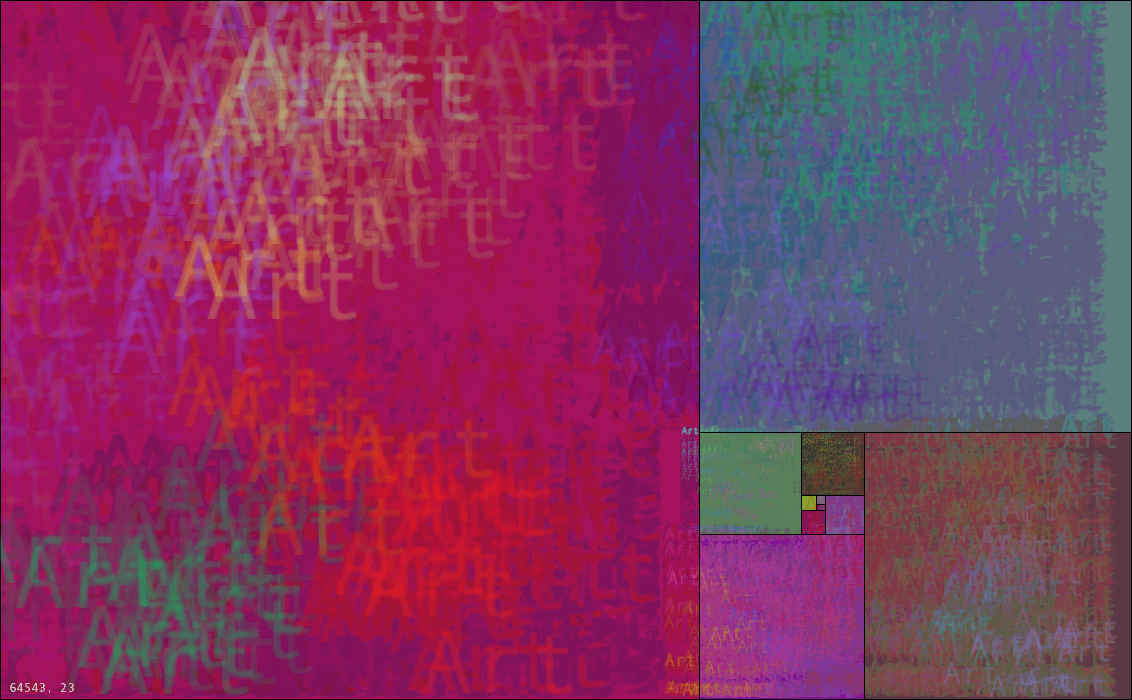
I’ve made many improvements to the Processing code for this “installation.” There are now controls that one can fiddle with to interact with the installation as it runs. Next project: build a control box with dials and switches to operate the controls. See Seurat, Square for progress on the black box.
Code at gitHub in the seurat folder.

 Circle and Square