
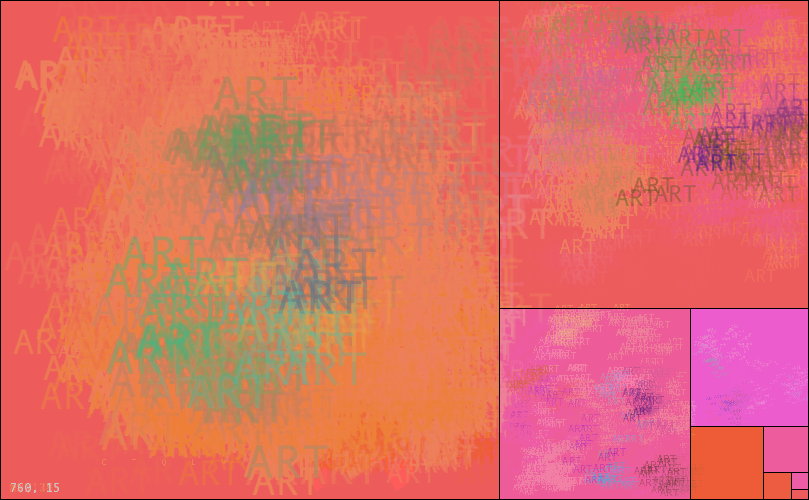
Below are the title and abstract for my presentation at the STEAM Factory Saturday, April 27, in Columbus Ohio (400 Rich Street).
Title: Processing Art
Abstract: We present an interactive art installation and offer a description of how it is constructed. A rapidly changing sequence of images is generated by via a computer program using mathematical principles — scaling, randomness, superposition of periodic waves, dynamics on a torus. These buzzwords and principles aside, the spectator-participant can interact with the program by tuning the color scheme and changing the letters and shapes generated. (If you like an image, we can save it and email it to you.) Code at github.
Acronym decode: STEAM = Science, Technology, Engineering, Art, and Mathematics
Another good art blog!
Just one of many paintings by Ken. I highly recommend his website


Mixed media 9×12 in. Working with the techniques I have used and adding rub-on-lettering (so 70’s ) . Not much of a story just a fun piece that I let take me where ever it lead me.


Detail from poster in New York City



Below is a letter (not published) that I submitted to the Wall Street Journal in response to EO Wilson’s op ed piece in the April 5, 2013 edition.
———————————–
April 9, 2013
Dear Editors:
I read with interest the article by E.O. Wilson, a distinguished
scientist whose work I greatly admire. Wilson addresses a problem that
concerns us all: the declining interest of young people in science.
I agree with much in Wilson’s article, e.g., that ideas play a key role,
that disciplined fantasies are the fountainhead of creativity. This
said, I take issue with the implication that mathematical semiliteracy
is an adequate preparation for a young person interested in science. What
is sufficient in one generation may not be in the next. Consider two
fundamental advances in physics: Faraday’s law of induction, which made
possible the electric generator, and Maxwell’s discovery that
electromagnetic waves propagate in a vacuum at the speed of light,
which made possible radio communication. Just thirty years apart, one
discovery was made without mathematics, while the other used the most
sophisticated mathematics of the day — and it did come from “staring at
the equations.”
One sees the same progression in biology. In the days of Linnaeus and
Darwin, mathematics played no role. But now whole fields of biology have
been created using mathematics. It is one thing to cut chromosomes into
pieces with enzymes. It is another to assemble the pieces into a map, a
dictionary of life. That was done with a sophisticated piece of
mathematics, the Smith-Waterman algorithm. Mathematics also plays a key
role in reconstructing the tree of life: when and how did species branch
off from their ancestors? Darwin would be pleased!
Back to Wilson’s concern — no student should be deterred from a
career in science by mathematics — but that same student should know
enough mathematics to collaborate fruitfully and to be conversant with
ideas his colleagues will use: statistical argument, model, simulation,
algorithm, etc. Better to enter the game with a full deck.
Sincerely,
James Carlson
Professor Emeritus
University of Utah

 Circle and Square