Artwork by Dylan Carlson.


I made this painting with Cheetah3D.
This is from a 10 megabyte rendered image. I made a 20″x26″ color print on foam board at Fedex/Kinkos.
Artwork by Dylan Carlson.
I made this painting with Cheetah3D.
This is from a 10 megabyte rendered image. I made a 20″x26″ color print on foam board at Fedex/Kinkos.
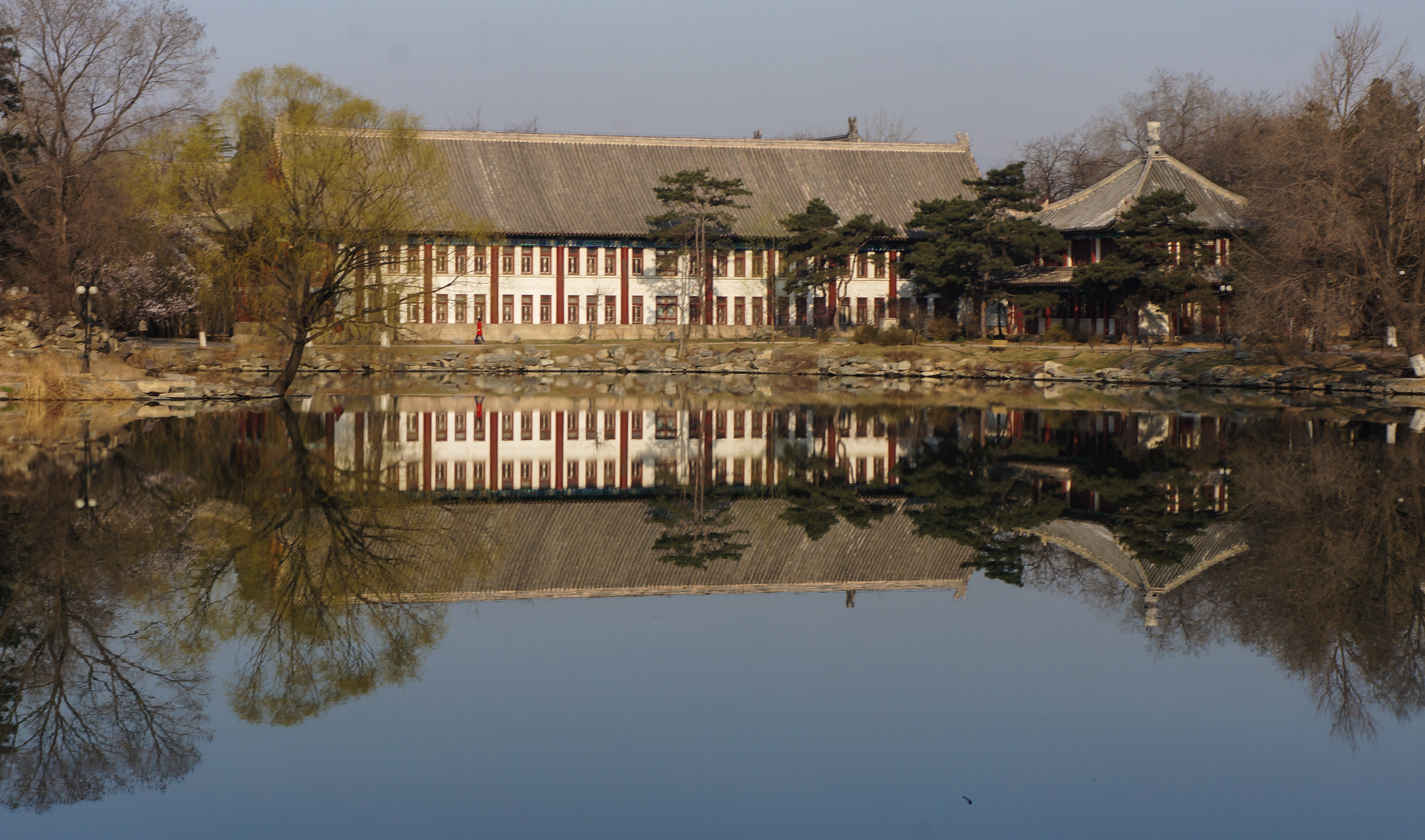
Peking University

Frame 1089 of a Processing animation. Code at github. Each square contains a number of particles whose position and color undergo Brownian motion. The radius of the particles follows a periodic sawtooth function. The overlay color of each square varies periodically and is determined by the position of an imaginary particle traversing a periodic path on a 2 or 3-dimentional torus in RGB space. The tempo of the animation oscillates periodically with a long period on the order of tens of thousands of frames.
This “work” will be shown at an installation at the STEAM Factory in Columbus, Ohio, on April 27.
zipTimer: an iPod/iPhone app for pacing piano practice, cooking, workouts, you name it.
An article in the New York Times by Jal Mehta of the Harvard Graduate School of Education notes that the US, despite years of reform efforts, ranks low compared to other industrialized nations: for 15-year-olds in 2009, the US ranked 14th in reading, 17th in science and 25th in math, behind Belgium, Estonia, and Poland. Here is one extract from the article:
HERE’S what the old debates have overlooked: How schools are organized, and what happens in classrooms, hasn’t changed much in the century since the Progressive Era. On the whole, we still have the same teachers, in the same roles, with the same level of knowledge, in the same schools, with the same materials, and much the same level of parental support.
Call it the industrial-factory model: power resides at the top, with state and district officials setting goals, providing money and holding teachers accountable for realizing predetermined ends. While rational on its face, in practice this system does not work well because teaching is a complex activity that is hard to direct and improve from afar. The factory model is appropriate to simple work that is easy to standardize; it is ill suited to disciplines like teaching that require considerable skill and discretion.
Teaching requires a professional model, like we have in medicine, law, engineering, accounting, architecture and many other fields. In these professions, consistency of quality is created less by holding individual practitioners accountable and more by building a body of knowledge, carefully training people in that knowledge, requiring them to show expertise before they become licensed, and then using their professions’ standards to guide their work.
By these criteria, American education is a failed profession. There is no widely agreed-upon knowledge base, training is brief or nonexistent, the criteria for passing licensing exams are much lower than in other fields, and there is little continuous professional guidance. It is not surprising, then, that researchers find wide variation in teaching skills across classrooms; in the absence of a system devoted to developing consistent expertise, we have teachers essentially winging it as they go along, with predictably uneven results.
Mehta notes the disparity in research effort between teaching and other professions:
Anthony S. Bryk, president of the Carnegie Foundation for the Advancement of Teaching, has estimated that other fields spend 5 percent to 15 percent of their budgets on research and development, while in education, it is around 0.25 percent.
And this:
… In the nations that lead the international rankings — Singapore, Japan, South Korea, Finland, Canada — teachers are drawn from the top third of college graduates, rather than the bottom 60 percent as is the case in the United States. Training in these countries is more rigorous, more tied to classroom practice and more often financed by the government than in America. There are also many fewer teacher-training institutions, with much higher standards. (Finland, a perennial leader in the P.I.S.A. rankings, has eight universities that train teachers; the United States has more than 1,200.)
A fascinating 1988 interview with Isaac Asimov on learning via the internet. Very prescient. Asimov was one of my teenage heroes — I read almost everything he wrote when I was in my science fiction phase. See clip at 2:45 for comments on baseball and mathematics.
zipTimer: an iPod/iPhone app for pacing piano practice, cooking, workouts, you name it.


I ran across a nice way of measuring the temperature of the CPU chip on the Raspberry Pi:
Do this:
$ cat >/usr/local/bin/temperature
/opt/vc/bin/vcgencmd measure_temp
$ chmod u+x /usr/local/bin/temperature

Then you can do this:
$ temperature
temp=57.3'C
zipTimer: an iPod/iPhone app for pacing piano practice, cooking, workouts, you name it.



 Circle and Square